Servers and Users
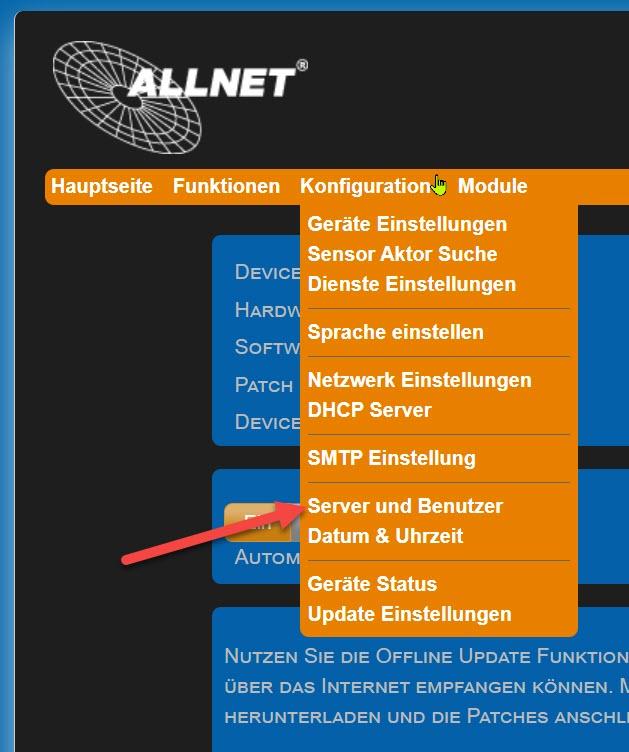
"User Settings" tab
In the "User Manager," you can create up to 10 users and assign them the appropriate permissions. These include permissions for FTP and SSH access, as well as the ability to grant other devices remote access to this device. Simply setting up a standard user is not advisable, because otherwise all websites will remain unprotected due to the open administrator access.
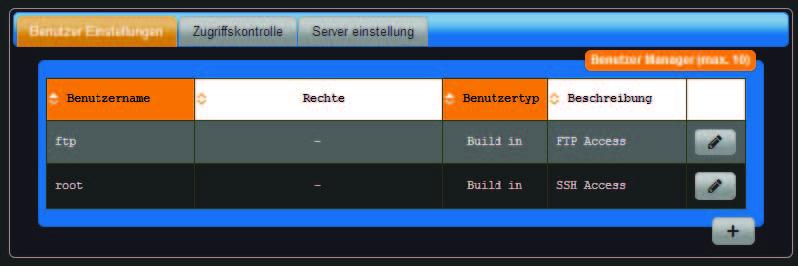
The "ftp" and "root" users are available by default and can be edited using the "pencil" button on the right.
• FTP username
This user can access all files on the device via the FTP protocol. When logging in for the first time, enter the username “ftp” in lowercase. The password is transmitted in plain text.
• Username: root
Advanced users can access the Linux operating system console directly. When logging in for the first time, enter the username “root” in lowercase.
These passwords absolutely must be changed!
Use the "+" button (bottom right) to add additional users. Depending on the user type—"Interface" or "Remote Control"—different permissions are available.
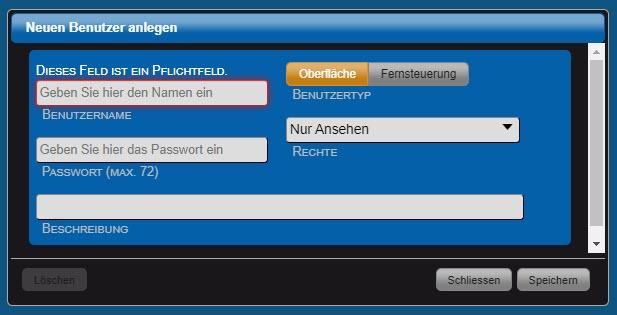
• Username Enter a username here.
• Password You must set a password here.**
• Description This description is for informational purposes only.
• User Type **The "User Interface" and "Remote Control" user types are available.
• Rights ** Depending on the user type, you can configure the permissions here with varying levels of detail. Permissions for the "Interface" user type:
- View Only (Surface inspection permitted)
- View & Analyze (Allows you to retrieve and analyze measured values and statuses)
- View & Control (Allows you to retrieve measurement values and status information, as well as control actuators/outputs)
- View, Control, & Analyze (Allows querying and analyzing measured values and statuses, as well as controlling actuators/outputs) ––View, Control, Analyze & Functions (allows for querying and analyzing measured values and statuses, as well as controlling actuators/outputs; access to the "Functions" menu is available)
- Administrator (The administrator has full privileges on the device's interface)
Permissions for the "Remote Control" user type:
Under "Main Page" > "Overview," all pages of the web interface are disabled. The "Functions" menu item is also hidden. The device can now only be controlled remotely.
- View Only (Allows retrieval of measurement values and statuses)
- View & Control (Allows you to retrieve measurement values and status information, as well as control actuators/outputs)
We strongly recommend that you create a user with the "Remote Control" user type and the "View & Control" permissions under the "User Settings" tab. Without this setup, other users on your network will not be able to read or control the API.
"Access Control" tab
Access to the web interface and the web pages containing configuration options is defined by the permissions in the "User Settings" tab. To enable access control for the interface, you must first create a user with administrator privileges.
When remote control is enabled, HTTP GET commands from another system can be used to retrieve the values of individual or all sensors and to control actuators or outputs.
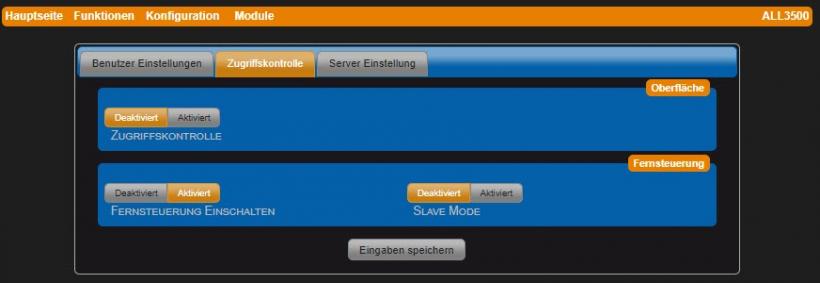
• Access Control ** To enable access control for the interface, you must first create a user with administrator privileges.
• Enable Remote Control via JSON API **Enable remote control for read and/or write access to the device. The permissions are configured in the "User Settings" tab.
We strongly recommend that you create a user with the "Remote Control" user type and the "View & Control" permissions under the "User Settings" tab. Without this setup, other users on your network will not be able to read or control the API.
You can find the appropriate JSON API at the following link https://msr.allnet.de/msr-handbuch/sdk-json-api
• Slave Mode **When "Slave Mode" is enabled, all pages of the web interface under "Home" > "Overview" are disabled. The "Functions" menu item is also hidden. The device can then only be controlled remotely.
"Server Settings" tab
In this tab, you can control access to the built-in server via the HTTP, FTP, and SSH protocols.
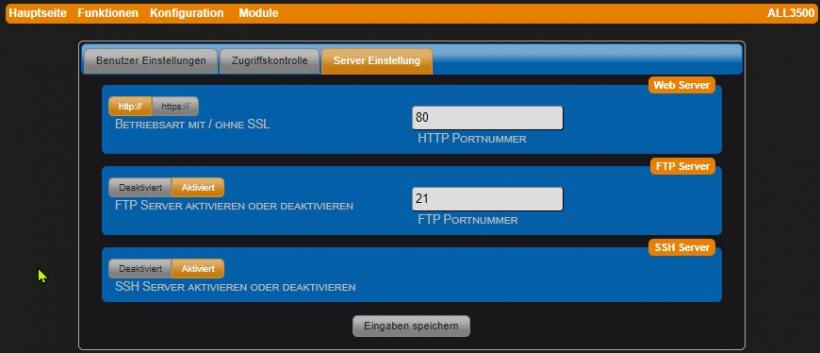
• Operating mode with or without SSL **
- http:// (Default: no encryption)
- https:// (with SSL encryption)
• HTTP port number ** Default port numbers: http:// = 80 / https:// = 443
• Enable or Disable FTP Server Default = disabled
• FTP port number **FTP port number: 21 (default)
• Enable or disable the SSH server **Default = disabled (SSH port number: 22).
You have the option to upload your own certificate. You'll find instructions on how to do this below.